Why Is 28 MPH the Max Wind Speed for Outdoor Lifts?
Outdoor lifts can appear stable on calm days, yet wind changes their operating environment quickly. Gusts can sway the platform, affect doors, stress guide systems, and reduce an operator’s control. This is why many manufacturers identify 28 mph as a stopping point for outdoor lift use. It is not a universal number for every model. The actual limit depends on the lift design, installation height, platform size, exposure, and manufacturer’s instructions.
So, What is the maximum wind speed for outdoor lift operation? David Cooper, a respected lift engineering consultant, explains, “Safe lift operation begins with respecting the conditions around the equipment.” His statement reflects a practical truth. Wind speed alone does not tell the whole story. A steady 25 mph wind may feel manageable, while a sudden gust can create a more serious hazard. A rooftop lift, coastal installation, and open construction site may experience very different wind forces.
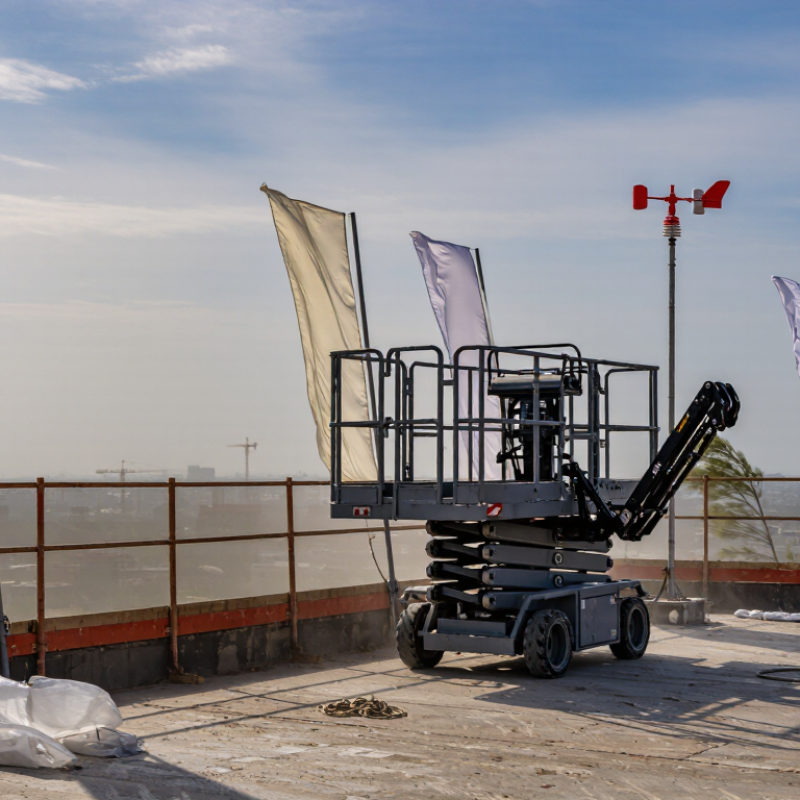
Small details matter. Watch flags, tree movement, loose materials, and changing gust patterns. Check the anemometer, if installed, and follow the operator manual rather than relying on personal judgment. Stop the lift when conditions exceed the stated limit. Better early than late.
There is also room for careful reflection. The 28 mph figure is useful, but it can create false confidence when treated as a guarantee. Operators should confirm the specific equipment rating, inspect exposed components, and consider visibility, rain, ice, and nearby structures. Safe decisions require measured information, experienced judgment, and the willingness to pause operations.
What the 28 MPH Wind Limit Means for Outdoor Lifts
For many outdoor lifts, 28 mph is a strict operating boundary. That equals roughly 45 km/h. The limit means operators should stop elevating or using the platform when wind reaches that speed. It does not mean the lift remains stable below it. Wind acts on the basket, rails, workers, and materials. A raised platform can behave like a sail. Even a lightweight panel may catch a sudden gust. Small errors matter.
Operators should check wind conditions before starting and throughout the task. An anemometer mounted near the work area gives more useful readings than a distant weather app. Wind readings near ground level can be misleading. Conditions often become stronger around buildings, corners, and open roofs. Stop work when gusts approach the limit, not only after crossing it. That judgment requires training and attention.
However, 28 mph is not universal for every outdoor lift. Some equipment has a lower rated limit, while certain models are designed only for indoor use. The equipment manual, site assessment, and local safety requirements must control the decision. A common field mistake is watching the average wind speed while ignoring gusts. That habit needs correction. Wind may be quiet at ground level and harsh at platform height. The safest decision can feel overly cautious, especially when a task is nearly finished. Rechecking the basket, securing loose materials, and lowering the platform may cost minutes, but ignoring changing wind can create far greater exposure.
How Wind Speed Affects Lift Stability and Passenger Safety
Why Is 28 MPH the Max Wind Speed for Outdoor Lifts?
Wind speed affects lift stability long before passengers feel unsafe. At 28 mph, or about 12.5 m/s, moving air can create strong lateral forces on cabins, platforms, guide rails, and doors. The NOAA National Weather Service classifies 25–31 mph as a “strong breeze,” capable of moving large branches and making walking difficult. An elevated lift has less protection than a vehicle at ground level. Its exposed surfaces can behave like a sail.
The 28 mph limit is not a universal legal rule. It is usually a conservative operating threshold set through engineering calculations, site conditions, and the lift manufacturer’s risk assessment. ISO 4302:2016 shows why wind actions must consider both average speed and gust effects. A sudden gust can produce uneven loading, sway, or inaccurate stopping at a landing. Passengers may feel only a brief shudder. The structure experiences more.
Site teams should monitor calibrated anemometers near the lift, not rely on weather apps alone. Wind readings at ground level may differ sharply from readings beside a tower or rooftop. Doors should remain closed, loose materials secured, and operations suspended when limits are reached. In practice, judgment still matters. A calm reading can change within minutes. That is the uncomfortable part.
Why Is 28 MPH the Max Wind Speed for Outdoor Lifts? - How Wind Speed Affects Lift Stability and Passenger Safety
| Wind Speed Range |
Approx. Wind Pressure* |
Typical Effect on an Outdoor Lift |
Stability and Passenger-Safety Considerations |
Recommended Operational Response |
0–10 mph
(0–16 km/h) |
0.26 psf
(0.012 kPa) |
Minimal movement of the platform or boom under normal conditions. |
Generally low wind-related risk, although rain, ice, uneven ground, or nearby structures may still affect safe operation. |
Operate only after completing the site inspection and confirming that the lift manual permits outdoor use. |
11–20 mph
(18–32 km/h) |
0.31–1.02 psf
(0.015–0.050 kPa) |
Noticeable sway may occur, especially when the platform is elevated or exposed to crosswinds. |
Loose materials, tools, and clothing can become difficult to control. Wind direction and gusts may create uneven loading. |
Increase monitoring, secure materials, keep gates and guardrails closed, and reassess conditions frequently. |
21–28 mph
(34–45 km/h) |
1.13–2.01 psf
(0.055–0.098 kPa) |
Sway and lateral forces become more pronounced; the platform may be harder to position accurately. |
The risk of loss of balance, falling objects, unexpected movement, and reduced control increases. A 28 mph limit is commonly specified for many outdoor aerial lifts, but it is not universal. |
Use only if the specific lift’s instructions allow it and the measured wind, including gusts, remains within the stated limit. Consider lowering the platform. |
Above 28 mph
(Above 45 km/h) |
Above 2.01 psf
(Above 0.098 kPa) |
Wind loading rises rapidly, and exposed platforms, signs, panels, or other materials can act like sails. |
Greater potential for excessive sway, structural loading, tip-over hazards, falling objects, and difficulty maintaining stable footing. |
Do not operate unless the equipment documentation specifically permits a higher limit under the current conditions. Lower, stow, and secure the lift. |
Key technical points
- Wind pressure increases approximately with the square of wind speed. For example, 28 mph produces about four times the idealized pressure of 14 mph.
- The 28 mph value is a commonly used operating limit for certain outdoor aerial lifts, not a universal limit for every model, platform, or work situation.
- Measure wind near the working platform when practical. Wind at height can be stronger than wind measured at ground level, and gusts may be more important than the average wind speed.
- Always follow the specific equipment manual, site risk assessment, applicable regulations, and the instructions of the responsible competent person.
*Approximate dynamic pressure calculated using q ≈ 0.00256V² psf, where V is wind speed in mph. Actual lift loading depends on gusts, wind direction, platform area, attachments, shielding, elevation, and equipment design.
Why Lift Manufacturers Set a Maximum Operating Wind Speed
Manufacturers do not choose 28 mph as a convenient round number. They set this operating limit around stability, wind loading, and predictable machine performance. For many outdoor lifts, 28 mph equals 12.5 m/s, the reference wind speed used in EN 280-1:2022 for outdoor mobile elevating work platforms. IPAF safety guidance also commonly identifies 12.5 m/s as the maximum operating wind speed.
Wind becomes more powerful with speed. At 12.5 m/s, basic dynamic pressure reaches approximately 96 N/m². A raised platform with two square metres of exposed area could therefore experience nearly 192 newtons of direct wind force, before gusts, people, tools, and materials are considered.
A plastic sheet can act like a small sail. The lift may still look stable, but its safety margin is shrinking.
The 28 mph figure is not a magic wall. HSE guidance recommends checking manufacturer instructions and measuring conditions at platform height, not only at ground level. Gusts can arrive suddenly. Open roofs, corners, and unfinished buildings can increase turbulence. The IPAF Global Safety Report 2024 continues to highlight overturning as a serious MEWP hazard. Real sites are messy. Some manuals remain conservative, while operators may trust calm ground conditions too much. That deserves reflection.
How Anemometers Monitor Wind Conditions During Lift Operation
Why Is 28 MPH the Max Wind Speed for Outdoor Lifts?
The 28 mph limit equals about 12.5 m/s. It appears in common outdoor lift guidance based on ANSI/SAIA A92 requirements. However, it is not a universal legal limit for every lift. OSHA requires operators to follow site conditions, manufacturer instructions, and safe operating procedures. A lift can feel stable below 28 mph, yet gusts may create sudden movement.
Anemometers provide the practical control point. Mounted near the platform, the sensor measures wind speed continuously. Better systems record both average wind and peak gusts. The World Meteorological Organization’s Guide No. 8 explains that averaging periods affect reported wind values. A short gust can be hidden by a longer average. That detail matters when a basket rises above a roofline or between buildings. Turbulence can increase quickly. A single reading can mislead.
Tips: Check the anemometer before every lift. Confirm its location and calibration status. Watch the display during elevation changes. Stop when readings approach the site limit, not after exceeding it. Review weather reports, but trust on-site measurements more. Experienced crews also inspect loose materials, because wind affects the load as well as the machine. This is where practice gets imperfect. A calm ground-level reading does not guarantee a calm working height.
What Happens When Wind Speeds Exceed the Safe Operating Limit
Why Is 28 MPH the Max Wind Speed for Outdoor Lifts?
The 28 mph limit is not an arbitrary number. It reflects how wind can reduce an outdoor lift’s stability, steering, and braking performance. However, the exact limit depends on the equipment, platform design, load, and manufacturer instructions.
When wind speeds exceed the safe operating limit, the platform may sway sharply or rotate against its controls. Guardrails, tools, panels, and other materials can catch the wind like sails. The risk increases near buildings, where gusts become turbulent and difficult to predict. Wind conditions can also change quickly at height. The ground may feel calm while the platform moves violently several levels above it.
Stop lifting operations when wind reaches the stated limit. If conditions allow, lower the platform carefully and remove workers from the area. Operators should never depend only on how the wind feels. A handheld anemometer, site weather reports, and direct observation provide better information. The lift must remain secured according to its operating manual and site procedures.
A common mistake is treating 28 mph as a comfortable working speed. It is a maximum, not a target. Gusts matter more than a short average reading. During inspections, check for shifted materials, damaged guardrails, unusual movement, and warning alarms before restarting. In real work areas, judgment is not always perfect. When the reading is uncertain, pausing the job is the safer decision.
Why Is 28 MPH the Max Wind Speed for Outdoor Lifts?
Wind-speed reference based on the Beaufort scale, with a commonly used 28 MPH outdoor-lift operating limit
Around 28 MPH, wind can create significant side loads, platform movement, and reduced stability for elevated outdoor equipment.
Above this point, the risk of sway, loss of control, falling objects, and structural stress increases. The 28 MPH value is not universal;
the equipment manufacturer’s instructions, site rules, and the most restrictive applicable limit always control.
Conclusion
Outdoor lifts commonly use a maximum operating wind speed of 28 MPH as a safety boundary, because strong or gusty winds can affect stability, movement, and passenger comfort. Wind pressure may cause the lift platform or cabin to sway, make doors harder to control, and increase the risk of unsafe loading or unloading. The limit is established through engineering assessments that consider the lift’s structure, height, exposure, braking systems, and expected operating conditions. What is the maximum wind speed for outdoor lift operation? In this context, it is generally 28 MPH, although the exact limit can vary according to the equipment and site requirements.
Anemometers continuously measure wind conditions near the lift, allowing operators or automated controls to respond when speeds rise. If wind approaches or exceeds the safe threshold, operation may be slowed, paused, or stopped, and the lift may be returned to a secure position. Regular monitoring and following the manufacturer’s operating instructions help protect passengers, staff, and equipment during changing weather.

 Kathy lift